Summary: Jankel engineers protected mobility on commercial chassis, integrating armor, blast seating and medi
A protected Land Cruiser leaving a Jankel workshop is not a luxury SUV with steel plates bolted on. The difference sits in details: door hinges that still close after a blast。a floor stiffened without stealing ground clearance, seats anchored to absorb energy rather than transmit it. Jankel, a British engineering firm, has built its reputation on that kind of integration. The company does not manufacture every component from scratch. It takes proven commercial chassis and turns them into vehicles that can carry people through routes where ambush, mine strikes and rough maintenance are ordinary planning assumptions. That choice matters. Commercial bases keep parts available and drivers familiar;
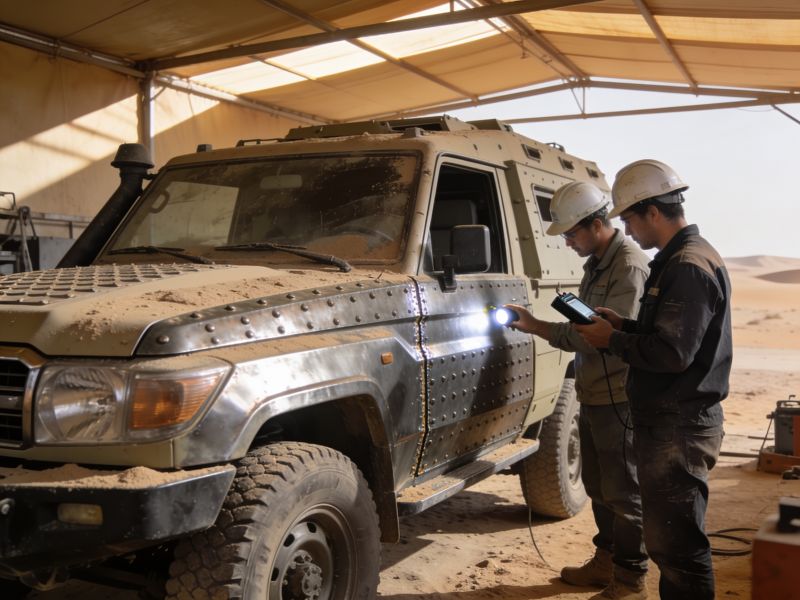
the protection package must then manage weight, center of gravity, cooling and electrical load without turning the vehicle into a sluggish bunker. Jankel's work is judged less by brochure numbers than by whether a crew can live with the vehicle for weeks.The Jankel portfolio reflects a practical reading of risk. Armored Toyota Land Cruisers, tactical pickups, ambulance conversions and mobile command units share a common logic: preserve the base vehicle's usability while adding protection where threats actually occur. A humanitarian fleet may need discreet armor and a low visual signature;a military unit may prioritize blast seats, weapon mounts and blackout lighting. Jankel has supplied protected vehicles and systems to defense。security and aid organizations, and its US arm has worked on similar protected mobility programs. Specific configurations vary, but the engineering tension is consistent. Every kilogram of armor changes braking, tires, suspension and fuel burn. Every electronic system adds heat and wiring. A credible integrator has to document those trade-offs, test them, and train the end user to recognize when the vehicle is being asked to do too much. Jankel's customers rarely buy a single vehicle;they buy a support relationship.
In protected mobility, certification is not paperwork. It is the difference between a vehicle that survives a defined blast event and one that merely looks armored. Jankel's engineering teams work with ballistic and blast standards。but the more revealing test is often operational: a convoy route with broken culverts, steep grades and long idling periods. A vehicle can pass a lab test and still fail in service if the air conditioning cannot cope with closed windows, or if a repaired door no longer seals. Jankel's value lies in treating protection as a system—armor, seating, medical layout, communications and maintenance access—rather than a stack of add-ons. That systems view also shapes medical conversions, where stretcher paths, oxygen storage and infection control compete for the same cramped space. A Jankel ambulance conversion is therefore a planning exercise as much as a build.Consider a typical Jankel protected Land Cruiser used by a security team in a fragile state. The crew may care about cup holders and radio charging points as much as armor. If the vehicle is too heavy, it chews through tires and brakes;
if the suspension is poorly tuned, fatigue sets in before contact. Jankel's approach tends to favor proven base platforms and modular protection, which makes repair and resupply less exotic. That is an unglamorous advantage. A vehicle that can be fixed by a local mechanic with common parts often stays in service longer than a bespoke machine with a perfect spec sheet. A convoy may cross a border post where the only fuel is diesel with unknown sulfur content;a protected vehicle that cannot tolerate that reality becomes a liability. The same logic applies to training: drivers need to understand altered braking distances, tire pressures and rollover risk. Jankel cannot control how a vehicle is used。but its design choices can make misuse less likely. Fleet managers notice that difference when a Jankel vehicle returns from a hard rotation with its doors still aligned.The protected vehicle market is crowded with promises. Jankel's position is more specific: a specialist integrator that connects commercial supply chains to military and security requirements. That position brings scrutiny. Customers increasingly ask for evidence—test reports, weight audits。maintenance histories, fleet availability. Jankel's challenge is to keep engineering discipline visible while scaling support across regions. Its vehicles are not the cheapest entry point, and they are not meant to be. The calculation is lifecycle cost: how many days a year the vehicle is available, how quickly a damaged panel can be replaced, how confidently a driver can move through a checkpoint. For Jankel, protection is a design habit, not a marketing layer. That is why its name carries weight in conversations about vehicles that must work when the route is uncertain. Jankel's credibility rests on that narrow, demanding promise.